Pages

Wednesday, 17 November 2021

Various Approaches and Methods of English Language Teaching.

 PhD Coursework

Paper – 2   


Preface

English Language Teaching has various techniques of teaching and learning English language or L2. Teaching methods of English language are constantly developing and changing time to time and different strategies are used. Many times, it can create questions and confusion that how to teach English language to fulfil the learners needs. So, various Approaches and Methods are very useful to enhance and emphasis on learning and teaching English language. Here researcher tries to study that which Approaches and Methods of English Language Teaching (ELT) are used in earlier period and currently which Approaches and Methods are being used and practices in ELT. Through this study researcher wants to find out most significant methods and approaches that language teachers can use today to teach English Language in classroom in different ways.

Keywords

ELT, Methods, Approaches, Techniques


A brief history of language teaching

In the current time, world population is bilingual or multilingual. So, people have knowledge of at least two or three languages. Specially country like India, we have various languages as a mother tongue but English is our (L2) or we can define it as a second language. English is the world's most widely studied foreign language. Before English language, Latin was dominant language in the field of education, commerce, religion, government etc in the western world. In 16th century, Latin became language of spoken and written communication. Classical Latin was taught and focus was given to grammar. Children were entering in "grammar school" in 16th to 18th century. In 18th century 'modern' languages began to enter and in 19th century Latin had various standard way of studying. After this Grammar Translation Method used by learners. In this method more emphasis given to teaching of grammar and translation is a way to study that language. More focus given on the reading and writing skills. This Grammar Translation Method worked from 1840 to 1946 in the world and today also it is widely practiced. This Grammar Translation Method is quite old method to teach English language.

After this Reform movement began in mid-19th century. People were refused Grammar Translation Method and focus should be given to teach and learn modern languages.  In the reform movement, greater emphasis given to spoken language not to the grammar. Reform movement was interested in developing naturalistic principal of language learning which came to known as the Direct method. 

Direct method focuses on the target language and teaching points were introduced orally. Oral communication skills were built up in Direct method.


Difference between Approaches, Methods and Techniques

In 1963 the American applied linguist Edward Anthony introduced three levels of conceptualization and association, which he labelled Approaches, methods and techniques. According to Anthony, "The arrangement is hierarchical. The organizational key is that techniques carry out a method which is consistent with an approach."


Approach - An approach is a set of correlative assumptions dealing with the nature of language teaching and learning. An approach is axiomatic. It describes the nature of the subject matter to be taught.

Method - Method is overall plan for the orderly presentation of language material, no part of which contradicts and all of which is based upon, the selected approach. An approach is axiomatic, a method is procedural.

Techniques - A technique is implementational that which actually takes place in a classroom. It is a particular trick, strategy or contrivance used to accomplish an immediate objective. Techniques must be consistent with a method, and therefore in harmony with an approach as well.

Approach - Design - procedure
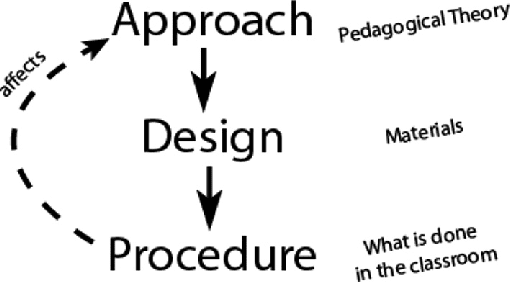


Richards and Rogers in 1982 approach expanded on Anthony's three level framework. Approach, design and procedure. Approach means pedagogical theory. Design means materials and procedure means what is done in the classroom.

 Approaches

 (1) The Oral Approach and Situational Language Teaching: -

 The oral approach began with the work of British applied linguist in the 1920 and 1930. Two major leaders of this movement were Harold Palmer and A.S. Hornby. These two of the most prominent figures in British twentieth century language teaching. This approach used close relationship between the structure of language and the context and situation in which language is used. In the oral approach, learner has to listen the language and he or she has to repeat after his or her teacher. In this approach teacher has control on the content not learner. Teacher decided what to teach and what not to teach. Here language learning becomes the habit formation. For ex, every morning teacher say good morning. Whether students understand or not but they repeat the same daily and it will become their habit to say good morning and they learn to speak good morning, so that is the oral approach and the Situational Language Teaching. This oral approach is useful for only beginners not for advanced learners. In this approach teacher put emphasis on grammar, vocabulary and pronunciation. As Palmer viewed grammar as the underlying sentence pattern of the spoken language. In this approach speech and structure were seen to be the basis of language and especially spoken ability. Language skills are learned more effectively if they are presented orally first then in written formation. The meaning of words can be learned only in a linguist and cultural context. Here are the examples that how to teach English language to the learners through oral approach in classroom.

For examples - 

Teacher - This is a pen.

Students - This is a pen.

Teacher - That is a window.

Students - That is a window.

(2) The Structural Approach: -

All languages have their own structure and acquire any particular language learner should have to follow particular pattern of this language. Through structural approach learner can learn English language fluently. Structural approach teaches to learn sentence structure, pattern of sentences in a very systematic way in which learner learn how and where to use particular words, sequence of sentences, arrangement of words etc. The structural approach is a technique where in the learner master the pattern of sentence. It includes various modes, patterns, phrases etc. It is known that language should be learn in a scientific way of selection in a sentence pattern, structures and vocabulary.

This approach as Kripa K. Gautam states "is based on the belief that language consists of 'structures' and that the mastery of these structures is more important than the acquisition of vocabulary. Since structure is what is important and unique about a language, early practice should focus on mastery of phonological and grammatical structures rather than on mastery of vocabulary." Kulkarni "emphasizes the teaching and learning of the basic items or materials that constitute the framework of language." Whereas according to Yardi 'structures' as an "internal ordering of linguistic item", and further adds that structures may be defined as "device that we use to make signal, to convey meanings, and indicate relationship." (Wikipedia)

This way of learning will be beneficial for students because they can achieve mastery over language. It is related with grammar and other functional skills like LSRW. This approach also known as aural-oral approach. 

For examples: -

           1. Mahi broke his toy.

The toy broke Mahi. 


2. I ate an apple.

 I am eating an apple.

3.             3. I play

    He plays

4.             4. Boy, two boys, Great - Greater - Greatest

 This approach is based on effective use of speech. In which grammar is taught and its structures too. In this approach focus should be given in sequence, types of patterns of sentences, grouping sentence patterns, phrase pattern etc.

 (3) Natural Approach: -

 In 1977, Tracy Terrell, a teacher of Spal11sh in California, outline ed "a proposal for a 'new' philosophy of language teaching which called the Natural Approach”. Krashen and Terrell's combined statement of the principles and practices of the Natural Approach appeared in their book, “The Natural Approach”, published in 1983. This Natural Approach use for the sake of communicative motive and for that without using native language learner have to acquire second language. Krashen and Terrell see communication as the primary function of language, and since their approach focuses on teaching communicative abilities, they refer to the Natural Approach as an example of a communicative approach. Here focuses should be given on vocabulary and language is use as a vehicle for communication.  In this approach language acquisition done in a natural way. Acquisition is an unconscious process and it develop naturally in children mind. During the process of language learning learners make mistakes but those mistakes are sign naturalistic development process.

Learners should develop self-confidence, anxiety and motivation for second language acquisition. Teacher should present more comprehensible inputs, use more visual aids and main focus should be given on listening and reading and speaking should be emerge automatically. Meaningful Communication is central point of this approach.

The Natural Approach "is for beginners and is designed to help them become intermediates."

Natural Approach is primarily designed to develop basic communication skills - both oral and written. Purpose of a language course will vary according to the needs of the students and their particular interests. To teach second language teacher should use charts, pictures, advertisement, visual aids, mime, dialogues in pairs, group work activities etc. In this approach learner’s role is to participate well and teacher’s role is to make interesting and friendly atmosphere of class and give practical activities to learners.

So, through this way learners acquires both first and target language in nonformal atmosphere and in natural way. This approach rejects the formal grammatical organization of language.  

 (4) Functional Approach: -

The functional approach given by Michael Halliday and J.R.Firth. They provided one of the best expositions of language functions, used the term to mean the purposive nature of communication. Functional approach teaches to use language for functional purpose. Because language can be learned for different perspectives here the main purpose is to use language for specific purpose. Halliday provided seven different functions of language:

·       The instrumental function

·       The regulatory function

·       The representational function

·       The interactional function

·       The personal function

·       The heuristic function

·       The imaginative function

         Functional approach also known as a functional notional approach.

 (5) The Lexical Approach: -  

 The lexical approach is a method of teaching foreign language described by Michael Lewis in early 1990s. This approach mainly focuses on lexical phrases and chunks. In which mainly students taught to be able about perceive pattern of language and meaningful sentence structure. Lexical approach focusses on vocabulary that how vocabulary use during dialogue. Chunks and phrases are important to teach because during speaking second language fluency is important and without chunks or expression it is not possible. Common lexical chunks include: ever, been, seen, heard and good morning, thank you etc.

 (6) Communicative Approach: -

This approach is learner centered approach. This approach teaches not only grammatical competence but social skills that how to say, why to say and when and where to say. This approach mainly focusses on fluency, accuracy, appropriateness. Hear teacher’s role is a co-participant not an authoritarian master. The goal of this approach is to make learners communicatively competence. In this approach, the teacher is seen as a facilitator of his or her students in learning process then correct errors. Teacher should use target language fluently and appropriately. Students use the content of language and social functions mainly not just linguistic structures. Students can do pair work, role play, drama and try to communicate in different social context. The teacher should focus on developing skills of the students. This approach emphasizes the communicative capability of the learners. Communicative competence includes the following competence;

·       Grammatical Competence

·       Speech Competence

·       Technical Competence

·       Socio- Linguistic Competence

(         (7) The Eclectic Approach: -

This approach combines various approaches and methods to teach language depending on the aims of the lesson and the abilities of the learners. This approach fulfil the learning requirement of the learners and it breaks the monotony of the class. This approach uses various theories, methods and techniques to gain a thorough insight about the subject. Here teacher has more flexibility. There are variety in the classroom. Classroom atmosphere is dynamic. One method can support the weakness of other and multiple intelligence in the classroom are better developed.

(8) Humanistic approach: -

The Humanistic approach marked its beginning around 1960’s. as a reaction against behavioristic and psychodynamic approach. This approach studies the psychology of human mind and analysis human behavior. The term humanistic derives from the word “Humanist” which means a person who has strong interest for human welfare values and dignity. The supporter of this approach is Carl Roger, Abraham Mashow, Rollo May, Clarke Moustaks, Charlotte Buhler. Humanistic language teaching is an approach based on learners emotional and social needs to be engaged in learning not only mind.

 Methods

 (1) Grammar Translation Method: -  

The grammar translation method is the oldest method of teaching second language. This method is also known as classical method. The grammar translation method dominated European and foreign language teaching like Latin and Greek from 1840s to the 1940s. In this method students first study the parts of speech and syntax in detail. The sentence of English and mother tongue were compared and contested side by side. Use of this method is very easy for teacher. This method tells that everything in English should be taught by translating into mother tongue. Teacher taught mainly grammars and its rules and it is explained in mother tongue, vocabulary and translation exercises. In this method mainly focus should be given on reading and writing. Native language use as medium of interactions. 

Example – 1) હું ક્રિકેટ રમું છું.

                      I play cricket.

 (2) Total Physical Response: -  

Total Physical Response (TPR) method is combination of speech and action. In which language should be taught through physical activities. This method developed by James Asher, a professor of psychology at San Jose State University, California, it draws on several traditions, including developmental psychology, learning theory, and humanistic pedagogy, as well as on language teaching procedures proposed by Harold and Dorothy Palmer in 1925. Language and vocabulary should be teaching through physical movement.

Asher sees successful adult second language learning as a parallel process to child first language acquisition. He claims that speech directed to young children consists primarily of commands, which children respond to physically before they begin to produce verbal responses. Asher feels adults should recapitulate the processes by which children acquire their mother tongue. This method is Natural method. Here learners have to listen carefully and respond physically. Teacher’s role is instructors and give feedback to the learners. Teacher can use these as a material to teach like pictures, realia, slides, and word charts.

Examples1) Mother – Wash your hand.

                     2) Friend – Hold this cup.

                     3) Teacher – shut the door.

 (3) Audio Lingual Method: -

Audio lingual method developed during outbreak of World War II and had a significant effect on language teaching In America. This method known as a “Army method” or “Oral method”. This teaching method based on behavior psychology. This method mainly focuses on teaching grammatical structures and the basic sentence patterns. This method practices these patterns by systematic attention to pronunciation and intensive oral drilling. In this method for teaching second language teacher uses dialogue from repetitive drills and limited vocabulary. Learner should be well train and reactive and teacher’s role is central and active because it’s a teacher dominated method.

(4) Suggestopedia: -  

Suggestopedia is a method developed by the Bulgari a psychiatrist educator Georgi Lozanov. Suggestopedia is a specific set of learning recommendations derived from Suggestology.  In the suggestopedia method focus should be given on use of music, classroom decoration, furniture etc. Lozanov believes most learning takes place in a relaxed but focused state. Here functional use of music is a therapy to learn language. Musical atmosphere can help students to learn without stress and feeling relax.  The music is specially selected to bring students into the optimum mental state for the effortless acquisition of the material. There are various activities like imitation, question and answer, and role play, listening activities, which concern the text and text vocabulary. Teacher’s role is to create situation and motivate students. Learner’s role is to participate voluntarily.

(5) Silent way: -

The silent way method first introduced by Caleb Gattegno in his book “Teaching Foreign Languages in School” in the year 1963. Gattegno known for the use of coloured wooden sticks called Cuisenaire rods and for his series Words in Colour, an approach to the teaching of initial reading in which sounds are coded by specific colours. In this method pronunciation is fundamental.  Here teachers have to be very silent in the classroom and teacher have to motivate students to speak second language in classroom.  Benjamin Franklin says that:

“Tell me and I forget,

teach me and I remember,

 involve me and I learn”.

Silence can be considered the best vehicle of the learning language. Because in silence students can be more focused and concentrate on task. Here teacher is natural observer and silent and students are active to participant in various activities, self-evaluator and problem solver.  Here teachers use Fidel charts, vocabulary charts for activities.

(6) Direct method: -

An attempt to teach second language as one could learning mother tongue is known as the direct method. As child learn mother tongue naturally in childhood similarly second language teach in this method. That is why it is known as natural method also. This method is against the grammar translation method. For learning second language or foreign language special environment should be created. Direct method is a method of teaching a foreign language, especially a modern language through conversation, discussion and reading in the language itself, without the use of the pupil’s language, without translation, and without the study of formal grammar. The first words are taught by ponding to objects or pictures or by performing actions. In this method teacher can use practical activities to teach language and during this time teacher must encourage the students for direct and spontaneous use of the foreign language in the class room. Focus must be given on speaking skills and more on pronunciation. Teacher shows gestures, postures and action and students can try to established sentence with the help of vocabulary. This method is based on “Learning by doing”.

(7) Task based language teaching (TBLT)

In this method students actively engage in communication through various tasks. Here students are free to use whatever vocabulary and grammar they know. Students will be exposed to a whole range of lexical phrases, collections and patterns as well as language forms. 

   Conclusion: -

Thus, there are various methods and approaches are there in English Language Teaching to learning and teaching and that can make language studies more innovation, interesting and easy for learners. To teach second language and various techniques are also used. But the main goal or final destination is one to acquire second language, because get command over English language L2 is essential. 


References


Brown, H Douglas. Principles of Language Learning and Teaching. Person Education, 1941.

Eclectic Appeoach. n.d. 11 2021. <https://en.wikipedia.org/wiki/Eclectic_approach>.

Lexical Approach. n.d. 11 2021. <https://en.wikipedia.org/wiki/Lexical_approach>.

Littlewood, William. Communicative Language Teaching. Cambridge University press, 1981.

Patel, Dr. M F and Praveen M Jain. English Language Teaching. Jaipur: Sunrise Publishers & Distributors, 2008.

Richards, Jack C and Theodore S Rodgers. Approaches and Methods in Language Teaching. Cambridge University Press, 1986.

Shahedadpuri, Komal. "Language, Basic Concepts, Theories & Pedagogy, English in use. ." n.d.s

Talukdar, Deblina. "Humanistic Approach Benefits Online Techi Debline Talukdar Lecture in Kishore." (n.d.).


Using Online and Print Resources


Ph.D. Coursework

Paper – 1 Research Methodology

Using Online and Print Resources


Preface

This 21st century is known as 'The Age of Knowledge and Information' and 'The Age of Technology'. So currently in the field of higher Education students have many opportunities to learn, acquire knowledge and information from various platforms and in many ways like e-resources are available as well as print resources are used. Specially as a scholar, researcher has to use various reading resources to work on their research area and expand the horizon of knowledge. This paper aims to discuss the online and print resources which are useful, importance of citing sources, need to archives the sources and practical advice of how to access those sources etc. 


Keywords : Online resources, print resources, citation, archive the sources.


Introduction

Major difference between undergraduate and postgraduate Study is that UG level teacher provides all the materials and give lectures but in post-graduation specially in Ph.D research, greater emphasis given to the Importance of independent research in the higher education. As a scholar, researcher has to do many things like identify various reading resources, locate resources appropriately, cite those sources accurately, evaluate and archive sources properly and remain up to date with the new developments and emerging trends of the specific research area or topic etc.

So, for the detail study, researcher has to use different reading resources because now in this digital age, there is greater demands and paradigm shift. So, in order to fulfil the changing needs, researcher need to use both online resources as well as print resources for their research work. Because in early time, only print resources were available but now time is totally changed. In the age of internet and technology researcher cannot rely only on the print resources but have to use some online sources on the other side these traditional methods of visit library and reading books are also beneficial we cannot avoid it. So, researcher should use both the platforms for better research work and good knowledge.


Aims and objectives of study


  • To introduce the online and print resources.
  • To explain the importance of citing and archive the sources.


Meaning and definition of online and print resources

1. Online resources - 

In general, web pages and documents on the internet that provide useful information. While an online resource is typically data and educational in nature, any support software available online can also be considered a resource. 

2. Print resources – 

Print form resources are those learning resources are published on paper medium which is called as print resources. These types of resources are also known as traditional based reading resources. Print resources were more popular before the arrival of electronic resources and now it is found existence in all the libraries except digital library.


Advantages and challenges of using Online resources -

 Advantages - 

  • Online resources are very user-friendly. Anyone can use, share and download.
  • Easy to access anytime from anywhere. No time limit or rules to follow. Only appropriate device and good internet are required. 
  • Online sources are easily portable.
  • It is quickly available for all the branches of education and provide global level information, so online resources are time saving not time consuming and online resources are very up to date with all the changes.
  • Not expensive.
  • For the researcher, online mode is very easy to publish and circulate anything.
  • Easy to archive everything.
  • Help in save papers.
  • Online resources are editable easily and locate the detail information appropriately.


Challenges-

  • Not everything is online. Many wrong information is available also so on those types of online platforms we cannot rely or use.
  • It is expensive also. To use some good online resources, we need subscription and have to pay fees also electronic equipment’s and internet are required.
  • For longer periods of time using screen can harm on readers eyes.
  • Online resources are depending on electricity.
  • Online resources are not always accurate or authenticated.
  • Users face network problems especially in rural area.
  • Online resources can be corrupt, damage and lost anytime.


Advantages and challenges of using Print resources -

 Advantages - 

  • Print resources are very easy to carry and handle anywhere anytime.
  • Print resources cannot harm to readers eyes while reading.
  • It is user friendly so very easy to make notes and highlight in Print materials.
  • Easy to archive. Print resources can be preserved for long time so there is no risk for corrupt or damage.
  • Reader can get sense of originality when they read from print resources.
  • Printed resources are more accurate or authentic in nature.


Challenges -

  • Print resources are limited and not everything is available in Print form.
  • Difficulty in portability because it is very hard to carry from one place to another.
  • Print resources occupies space.
  • Print resources are expensive in use.
  • In print resources it is very difficult to edit, make changes and to add something once printed.
  • For use of print resources like from library required license or I -card, permission etc.


   Researcher has to use primary and secondary sources for the research. For that any researcher has to use online resources as well as print resources to collect data and information. So as a research scholar, we have to know about which types of Online resources and print resources are available and how to use it wisely in a proper way. So, here various online and print resources are discussed.


'Always record the route you take, whether via online or printed sources'.


Online Resources: -

          For using online resources or electronic resources, researcher required basic knowledge and skills of using internet, searching, ability to use web browser, computing expertise, use of Microsoft word, to book mark websites and download and export data etc. Practice is also required for using electronic resources because, 'Preparation is key to effectiveness in scholarly research'. First identify what is available online and familiarize yourself with online resources through public access websites. 

(1) Internet

The Internet is a multimedia resource – you will find not just text, but images, video clips, audio material and so on. With the help of internet everything is possible in a very easy way. Researcher has now all the information on their fingers. With help of internet user can access all the materials, libraries, online course, websites, attend webinars and conferences, publish papers and books, online tutorial, many open access resources available on internet. Through this practice researcher can develop their search skills and know about how to evaluate data and information.

   (2) Google

Google provides various facilities so that doing work will be very easy. Through Google researcher can search, read, download any information from anywhere and anytime. Specially all the Google Apps are very useful in research. Specially researcher can mostly use Google Scholar and Google Book. 

 Google Scholar allowed you to search a range of articles, books, scholarly publication of various discipline. Google Books offers virtual library. Copyright books can open with limited pages and non-copyright books can open, read, print and download also. But two important things researcher should keep in mind that while using Google books kindly check that bibliographies is available appropriately or not in any particular book. Second whatever books researcher will use but they have to copy the URL of that book at same time while using it for work citation. Because otherwise you have to search it again that book which is sometimes difficult as well as time consuming and some time again it can't available.

(3) Wikipedia 

Wikipedia is world's largest encyclopedia. It is open access site for anyone and from anywhere. Anyone can edit and add information because it's work collaboratively. Wikipedia provides authors biography, external links and cites for further information. There are some key advantages are there for using Wikipedia site like, 

Online reading sources can be editing and updating frequently so information available is up to date. Wikipedia provides recent events and developments before compare to other sites. As a researcher or anyone can create a password and user ID of Wikipedia, because Wikipedia will allow you to contribute social construction of knowledge by joining some forums and can checking sours and content accuracy, adding some information, provide suggestions and guidance, give other sites and external links etc. This Wikipedia page is very easy to cite.

In using Wikipedia there are some challenges also like, anyone can make changes in Wikipedia and on internet information are overloaded so it is risky also. Many wrong information is also available on internet. So as a researcher use this resource wisely and develop your own comparative evaluative skills for accessing information and crosscheck that information is useful in your research work or not. 

 (4) e - books

There are number of books and many scholarly primary titles are available online as a e - books. So, it is great resource to read online and download also. Bartleby, Kindle, Amazon's e - book reader system, Project Gutenberg, Literature online etc provides various e-reading resources. This type of reading facilities can save time, efforts and travel expenses also. 

 (5) Online dictionaries

There are number of online dictionaries are available online which is very helpful for researchers during reading and writing research papers, articles and thesis. This type of online dictionaries gives appropriate meaning of the particular word and provide synonyms and antonyms of that word. For example, researcher can use Oxford English dictionary, thesaurus etc. These types of dictionaries use online as well as download in your devices.

 (6) Digital Library

In the era of science and technology now library also available online. So, this will be more beneficial to researchers, students and reader to use this. ACM Digital Library, Government of India has created National Digital Library of India for students of all subject. It contains 4 crore 60 lakhs books. 

 (7) e - journal

 e - journals provides authentic knowledge and information on various topics related to the particular area of researchers. Journals are available online of various disciplines so researcher can choose their area and brows. For example, in ELT area some online journals are very helpful like Cambridge University Press, EBSCO Databases - Communication & Mass Media Collection, Jstor, Oxford University Press, Sage Publication, Scopus, Web of Science, Springer, I - scholar, Shodh Sindhu etc. During literature review these journals will help a lot to researchers to identify that which kind of work already done in their area and particularly in the particular topic.

(8) Blog 

Blog is very innovative and latest resource for researcher. Many intelligent people are writing blogs on various topics which can help in research like on films, novels, historical places and many more. It is very easy to access. Researcher can write and publish their own blogs also in their research area.

 (9) Academic websites

Many websites like Research gate and Academia.edu are very fruitful websites to researchers to read research papers and articles on their research area. So, it will be benefited during literature review. Researcher can also publish their research papers and articles on this platform.

(10) Online Course

To learn more related to the research area researcher should join various online courses related to their research area so through this researcher will get more information and knowledge on that particular topic. Some online courses are free and some are paid certificate course. For example, MOOC, Edx, Coursera, Khan Academy etc. These courses are easy to access and with punctuality within given time students can complete this course. 

 (11) Multimedia 

Movies, You Tube, Web series, documentary are also very helpful Multimedia resources to the research scholar. Because some topics related sources researcher can take from this. 

 (12) Shodhganga and Shodhgangotari

Researcher can find thesis and synopsis on Shodhganga and Shodhgangotari. Just search particular topic or research area so easily it is available online. University vice also available. So, researcher can get idea that what research have been done in that particular area and what research work still remain in that area. So, in literature review it is helpful to read from this particular resources. Now researcher has to digitally locate their thesis on this website compulsory. So, it is easy and beneficial for future researchers as well to get information related topics and other aspects.


Print resources

As time change, reading resources and technology updated but in 21st century many people still using radio when television is also available. In same way online resources are there but print or physical resources are still in demand and researcher use these resources. The creation of a new medium does not necessarily invalid-date the former ones. 

 (1) Library 

To use library and read books is one of the best habits of any person. When we talk about researcher, he or she must have to visit library and search books there. Visit University library, central library, other states and National and International libraries also to find reading sources. This is old technique but still working well. When you read books in library you can feel the atmosphere of that place. Some old books and copies are preserved in libraries not available online. Researcher can use journals, articles and different magazines also related to the area. To read from physical copy you can get amazing feeling of originality. To search books on your own is best practice as well and researcher can spend more time with books in library.

(2) Newspapers

Whether your research is historical or contemporary, newspapers provide an important source of book and performance reviews, publishers’ advertising, serialisations, editorial comments and author interviews, articles and information. Increasingly, some of important newspapers like Times of India, Indian Express, Hindustan Times etc. One major benefit of reading newspaper is you can keep yourself up to date with the current information and knowledge.

 (3) Dictionary

 Researcher should always carry dictionary or thesaurus with him or her. During writing and reading it will help you to understand some difficult words and jargons better. For example, Oxford English Dictionary is good. 

 (4) Theses

To refer previous theses is important for researchers. So, in library researcher can easily identify the theses of related to their area of interest. Theses is big reading resource and help to know that what research have been already done and what will still remain to do. So in literature review also researcher can use it.

 Importance of citing sources

Citing resources is ethically and legally very important work for all researchers. Cite each and every thing which is used directly or indirectly from online or offline sources. All sources, whether online, printed or unpublished, need to be cited as fully and as accurately as possible. Before using any sources check the work cited and bibliographies of that work. 

Accessing and using archives: practical advice

During research each and every thing researcher should archive from first to last steps of their research. Locate and archive everything is the best practice to save your time and will use anytime in future as well. Maintain everything perfectly and take backup and save everything well. 

Participating in a research community and keeping up to date

So, what are the benefits from joining scholarly learned societies, and what expenses are you likely to incur?

Presentations, workshops, networking

As a researcher to participate in various conferences, webinars, Seminar, workshop is very Important and fruitful as well. Make your 'Research Community'. Communicate with scholars, other researchers, professors, librarians they all are knowledgeable. To join scholarly learned people’s society will provide more benefits in the particular area.  Attending conference and Seminar will give confidence and through this knowledge of this area will improve. Conferences, seminars, workshops and symposia are also the venues where academics meet one another – so if you are thinking of graduate study and research as a part of career, this is an essential part of your career development and will give you a more immediate sense of scholarship in your area of study and Networking you can built through this. Conferences, workshops, seminars or electronic publications specifically aimed at postgraduate students. There is a growing awareness throughout the tertiary-education sector that students learn and acquire skills very effectively from one another. Events organized specifically for postgraduate students will offer an excellent venue for networking with fellow researchers, allow you to exchange ideas in a less intimidating setting, and perhaps shape your first publication – all of these are key skills for good research. Regularly attending conferences and research seminars will ensure that you remain up to date about the major trends and developments in your area of research. With the help of social media, for example - Facebook researcher can join their research community, topic related groups etc. meet scholars through the social media etc. 

To sum up

So, researcher can use online and print both resources. Because online and print resources are crucial and needed in the research work. This assignment suggests various sources and some good skills which can help a lot to researcher for their research work.

References

Correa, Delia da Sousa and W R Owens. The Handbook to Literary Research. Londonn and New Yourk: Routledge, 2010.

G, Annapure S and Ajay M Pandit. n.d. October 2021. <http://ignited.in/I/a/109791>.

What is Online Resources. n.d. October 2021. <https://www.igi-global.com/dictionary/use-of-e-resources-through-consortia-with-special-reference-to-college-libraries/21050>.

Wu, Michelle M. "Why Print and Electronic Resources Are Essential to the Acdemic Law Library." ResearchGate 2005.